
The Death of Keywords & The Rise of Entities
Traditional SEO is flatlining. The tactics that worked brilliantly a few years ago are now the exact same tactics getting agencies fired today. If you are still relying on stuffing "plumber in Chicago" into an H2 tag and praying for a rankings bump, you are playing a game that Google stopped caring about.
With the rollout of Search Generative Experience (SGE) and AI Overviews, Google's algorithm no longer reads web pages like a human skimming a newspaper. It doesn't care about your keyword density. It cares about Entity Density. We are no longer optimizing for search engines—we are optimizing for AI data models.
Strings vs. Things: The Fundamental Shift
For two decades, Google operated as a massive matching engine. You typed in a "string" of text, and Google scoured its index for websites containing that exact string. It was easily manipulated.
Today, Google operates on a Knowledge Graph. It connects "things" (Entities). An entity isn't just a keyword; it is a real-world object—a specific business, a CEO, a concept, or a location—with established facts, relationships, and undeniable authority.
When an AI model generates an answer, it doesn't look for the site with the most keywords. It looks for the entity with the most verified, structured data backing it up.
Why Keyword Density is a Trap
AI models understand context natively. If you over-optimize a page for exact-match phrases, you no longer trick the algorithm; you trigger its spam filters. The new metric of success is how well your brand connects to established concepts in the Google Knowledge Graph.
To do this, you have to speak the machine's native language. That language consists of two critical components: your Google Business Profile (GBP) and your Schema Markup.
How Agencies Must Pivot (The 3-Step Survival Guide)
Adapting to entity-first SEO requires a fundamental shift in agency operations. Here is how you build a digital moat around your clients.
1. Claim and Harden the Local Entity
Your Google Business Profile is your anchor entity. It is the undeniable proof to Google that a business exists in physical space. It must be perfectly synced, constantly updated, and completely free of conflicting data across the web. A stale GBP is a dying entity.
2. Inject Context with Dynamic Schema
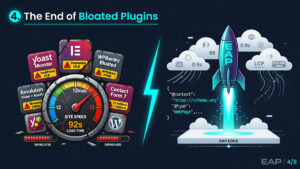
Stop using generic, out-of-the-box SEO plugins that only output basic WebPage schema. You need structured, nested data that explicitly tells the AI: "This business is the exact same entity as this GBP, this founder, and these social profiles." You have to map the relationships for the bot.
3. Monitor Entity Decay
Stop waiting for a monthly Google Search Console report to realize a client lost 30% of their traffic. Traffic doesn't drop overnight; it slowly bleeds out as competitors steal your entity relevance. You need a radar that tracks keyword and entity decay in real-time so you can pivot before the client ever notices.
The EAP Advantage: Automating the Entity Moat
Doing this manually for a single website is incredibly difficult. Doing it across an agency roster of 50 or 100 clients is impossible without tripling your headcount and crushing your profit margins.
- You can't manually check 50 GBPs for unwanted changes every day.
- You can't manually write flawless JSON-LD schema for hundreds of pages.
- You can't manually spot traffic decay across thousands of Search Console queries before it's too late.
That is why we built the Entity Authority Platform (EAP). EAP connects directly to the raw Google APIs. It automates your GBP synchronization, injects flawless Schema Pillar Pro data, and runs an Opportunity Radar to catch decay and quick-win keywords instantly.
Stop Fighting the Algorithm.
Don't let SGE wipe out your agency's results. Start building impenetrable digital moats with raw data power.
Explore Agency Plans